



Exercise Prescriptions for Cardiovascular Health in Adults: 2026 ACC Scientific Statement
Myers et al. | Journal of the American College of Cardiology (JACC) | Article in Press
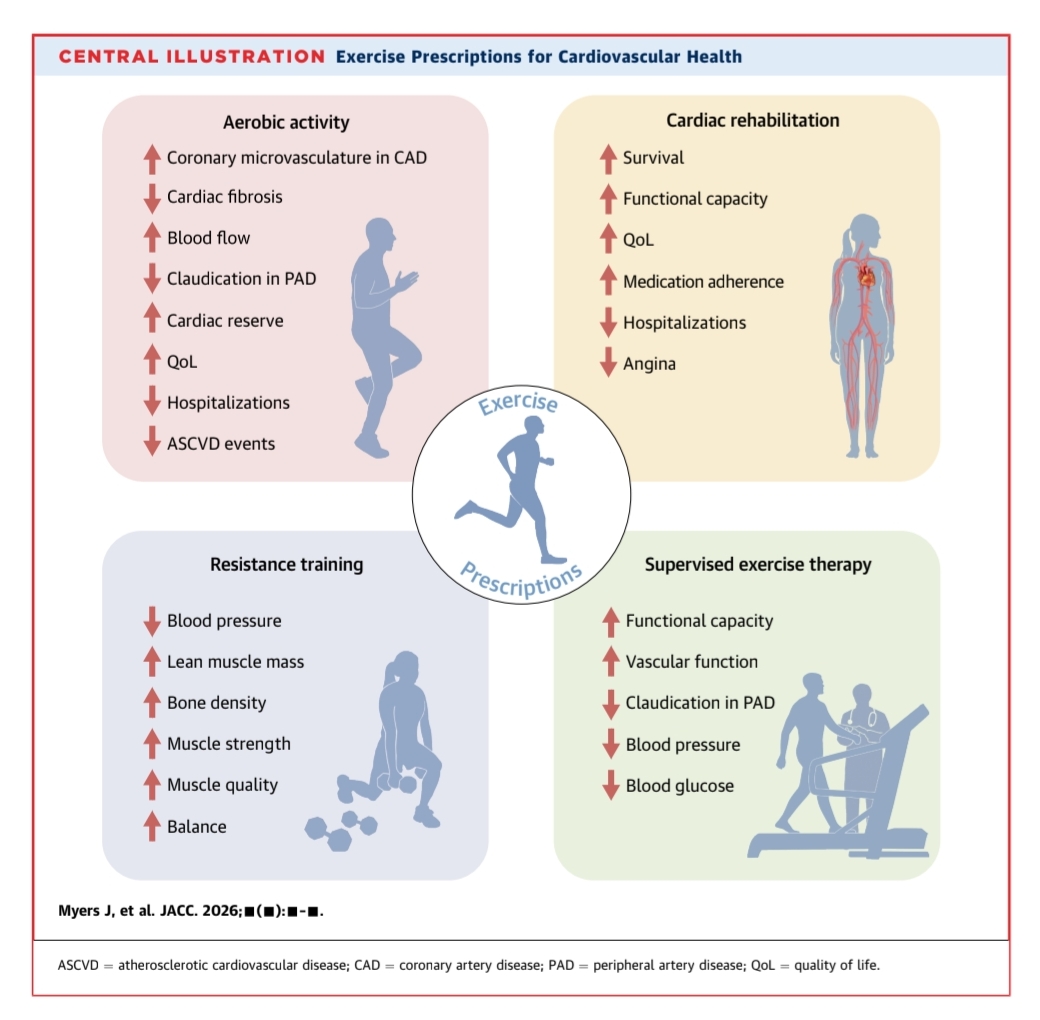
Overview
The 2026 ACC Scientific Statement emphasizes that exercise should be a core component of cardiovascular disease (CVD) prevention and treatment, yet it remains underused in routine clinical practice. The greatest absolute benefits occur when sedentary individuals begin exercising, with diminishing but continued benefits at higher activity levels. Low cardiorespiratory fitness is a strong predictor of adverse outcomes, comparable in prognostic importance to smoking, hypertension, dyslipidemia, and diabetes.
1. General Exercise Prescription: FITT Principle
Aerobic exercise
Frequency: 3–5 days/week.
Intensity: Moderate or vigorous.
Time: 20–60 minutes/session.
Target: 150–300 minutes/week of moderate-intensity activity or 75–150 minutes/week of vigorous-intensity activity.
Volume: Approximately 500–1,000 MET-minutes/week.
Weekend warrior pattern: Concentrating activity into 1–2 days may provide cardiovascular benefits comparable to distributing it throughout the week.
Resistance training
Frequency: At least 2 days/week.
Volume: 1–3 sets of 8–12 repetitions.
Starting intensity: 40–60% of one-repetition maximum (1RM), progressing toward 60–80% as tolerated.
Balance training
At least 3 days/week for individuals at risk of falls or with frailty.
Daily steps
Meaningful benefits begin at approximately 2,500 steps/day.
Around 7,000 steps/day is associated with substantially lower mortality compared with 2,000 steps/day.
A practical target is 4,000–8,000 steps/day, individualized to the patient's capacity.
Exercise intensity assessment Intensity can be assessed using heart rate reserve, metabolic equivalents (METs), symptoms, or cardiopulmonary exercise testing (CPET) thresholds. A Borg Rating of Perceived Exertion (RPE) of 12–14, corresponding to “somewhat hard,” is a practical guide, particularly in patients taking β-blockers.
Sedentary behaviour Prolonged sitting is associated with adverse health outcomes, and meeting recommended exercise targets may not completely offset its risks. Patients should be encouraged to interrupt prolonged sitting regularly.
2. Disease-Specific Exercise Recommendations
Coronary Artery Disease (CAD)
Cardiac rehabilitation (CR) is a key intervention following myocardial infarction (MI), percutaneous coronary intervention (PCI), coronary artery bypass grafting (CABG), or spontaneous coronary artery dissection (SCAD), and in patients with stable angina.
CR is associated with approximately 26% lower cardiac mortality and 18% fewer hospital admissions.
Patients with angina should exercise below their symptom threshold. Prescribed nitroglycerin may be used before exertion when clinically indicated.
Peripheral Artery Disease (PAD)
Supervised exercise therapy is a first-line treatment for intermittent claudication.
Patients walk until moderate or near-maximal claudication discomfort develops, rest until symptoms resolve, and then repeat the cycle.
Supervised exercise can improve walking distance by approximately 180 metres.
Heart Failure with Reduced Ejection Fraction (HFrEF)
Cardiac rehabilitation and structured exercise improve functional capacity and clinical outcomes.
In the HF-ACTION trial, exercise training was associated with an approximately 11% reduction in the composite outcome of all-cause mortality or hospitalization in adjusted analyses.
Heart Failure with Preserved Ejection Fraction (HFpEF)
Exercise improves exercise capacity and quality of life.
A definitive benefit on major clinical events remains unproven.
Hypertension
Exercise can reduce 24-hour ambulatory blood pressure by approximately 5–6 mmHg systolic and 3–5 mmHg diastolic.
Multiple exercise modalities can be beneficial.
Avoid exercise when resting blood pressure exceeds 200/110 mmHg until appropriately assessed and controlled.
Avoid breath-holding and the Valsalva manoeuvre, particularly during resistance training.
Obesity
Exercise alone generally produces modest weight loss and should be combined with dietary intervention when weight management is a goal.
Approximately 60–90 minutes of daily activity may be required for long-term weight maintenance in some individuals.
Walking is a practical low-impact option; higher-impact activities should be selected according to joint health, fitness, and individual tolerance.
Resistance training helps preserve muscle mass during substantial weight loss, including weight loss associated with GLP-1 receptor agonists or bariatric surgery.
Older Adults
Exercise prescriptions should be individualized according to frailty, functional capacity, and comorbidities.
Frail individuals may benefit from prioritizing strength and balance before progressively introducing endurance training.
Useful functional assessments include:
Six-Minute Walk Test (6MWT)
Timed Up and Go (TUG)
Sit-to-Stand Test
Cardiomyopathies and Myocarditis
Hypertrophic cardiomyopathy (HCM): Mild-to-moderate exercise is safe for many patients, with recommendations individualized according to symptoms and risk.
Arrhythmogenic cardiomyopathy: High-intensity or competitive endurance exercise may worsen disease progression and arrhythmic risk.
Dilated cardiomyopathy: Patients with LMNA or FLNC-associated disease require particular attention to arrhythmic risk and individualized exercise planning.
Myocarditis: Strenuous exercise is generally restricted for 3–6 months following symptomatic myocarditis, with return guided by clinical reassessment.
3. Exercise Testing
Routine exercise testing is generally unnecessary for most asymptomatic individuals and clinically stable patients before beginning low-to-moderate-intensity physical activity.
Potential disadvantages include false-positive results, limited ability to predict myocardial infarction or sudden cardiac death, unnecessary downstream investigations, and delays in initiating exercise.
Exercise testing may be warranted in patients with:
New or unexplained symptoms.
Recent MI or clinical deterioration.
Advanced heart failure.
Plans to undertake vigorous exercise when clinical assessment indicates testing is appropriate.
HCM or adult congenital heart disease, where CPET may provide valuable functional and prognostic information.
Indicators of training improvement
An increase of at least 1 MET on treadmill testing.
An improvement of more than 50 metres on the 6MWT.
These thresholds should be interpreted in the context of the testing protocol, measurement variability, and the patient's clinical condition.
4. Exercise Safety
Exercise-related cardiovascular events are uncommon, although risk varies with age, underlying disease, exercise intensity, and individual risk factors. One estimate cited for men is approximately one exercise-related sudden cardiac death per 1.5 million exercise sessions.
Patients should stop exercising and seek urgent medical assessment if they develop new chest discomfort suggestive of myocardial ischemia, syncope, or other concerning symptoms.
Important contraindications to exercise include:
Unstable angina.
Severe symptomatic aortic stenosis.
Acute myocarditis.
The complete list of contraindications and precautions should be checked against the original scientific statement and the patient's clinical condition.
5. Wearables and Cardiac Rehabilitation Delivery
Wearable activity trackers may increase daily activity by approximately 1,800–2,600 steps/day, with better results when combined with clinician support and behavioural interventions.
Despite established benefits, fewer than one-third of eligible patients worldwide participate in cardiac rehabilitation. Home-based, hybrid, and virtual rehabilitation models may improve access and participation.
Digital interventions may be less effective in socioeconomically disadvantaged populations unless barriers such as affordability, digital literacy, and access to technology are addressed.
6. Clinical Take-Home Messages
Ask every patient about physical activity during routine clinical encounters.
Recommend at least 150 minutes/week of moderate-intensity or 75 minutes/week of vigorous-intensity aerobic activity, supplemented by resistance training at least twice weekly.
Encourage sedentary individuals to start with achievable activity levels and increase gradually.
Individualize exercise prescriptions according to cardiovascular disease, frailty, symptoms, and functional capacity.
Refer eligible patients to cardiac rehabilitation.
Avoid unnecessary exercise testing that delays appropriate physical activity.
Address prolonged sedentary time in addition to meeting weekly exercise targets.
Improve equitable access to supervised, home-based, and digitally supported rehabilitation.
Bottom line: Exercise should be treated as a core component of cardiovascular prevention and management. The most effective prescription is one that is evidence-based, individualized, safe, and sustainable.